In development · Free · Open source planned
Forge VFX
Motion graphics and compositing, running entirely on your own GPU.
A multi-layer timeline, node-based effects, 3D layers and cameras, and local AI generation of video, images and audio. Written from the ground up in C++ on its own Vulkan and OpenGL renderer.
01 · Generate
Describe the shot.
Your GPU renders it.
Draw a region on a still, write a prompt, and Forge generates the clip on your own hardware, then drops it onto a new layer ready to composite. No uploads, no queue, no credits.
- Type
- Video
- Model
- Wan 2.2 TI2V 5B
- Area
- Region only, 908 × 642
- Frames
- 65
- Steps
- 20
- Seed
- 7
Prompt
Ready.
The demo runs at presentation speed. Generating a clip like this takes minutes on a desktop GPU; Wan 2.2 5B is comfortable at 12 GB of VRAM and runs from 6 GB.

From clip to scene
The generated flames are feathered back into the photograph they came from. A mask keeps them inside the firebox, a Particle System layer adds snow that only falls behind the window glass, and three candle layers animate the mantel. One project, one timeline, one export.
- VideoWan 2.2, LTX-Video, HunyuanVideo 1.5, CogVideoX
- ImageFLUX.1 schnell, SDXL, Stable Diffusion 3.5
- AudioStable Audio Open
- MotionDepth-driven parallax and orbit from a single still
First run offers a one-click setup that installs a private Python and PyTorch, the CUDA build when an NVIDIA GPU is present, touching nothing else on the system.
02 · Compose
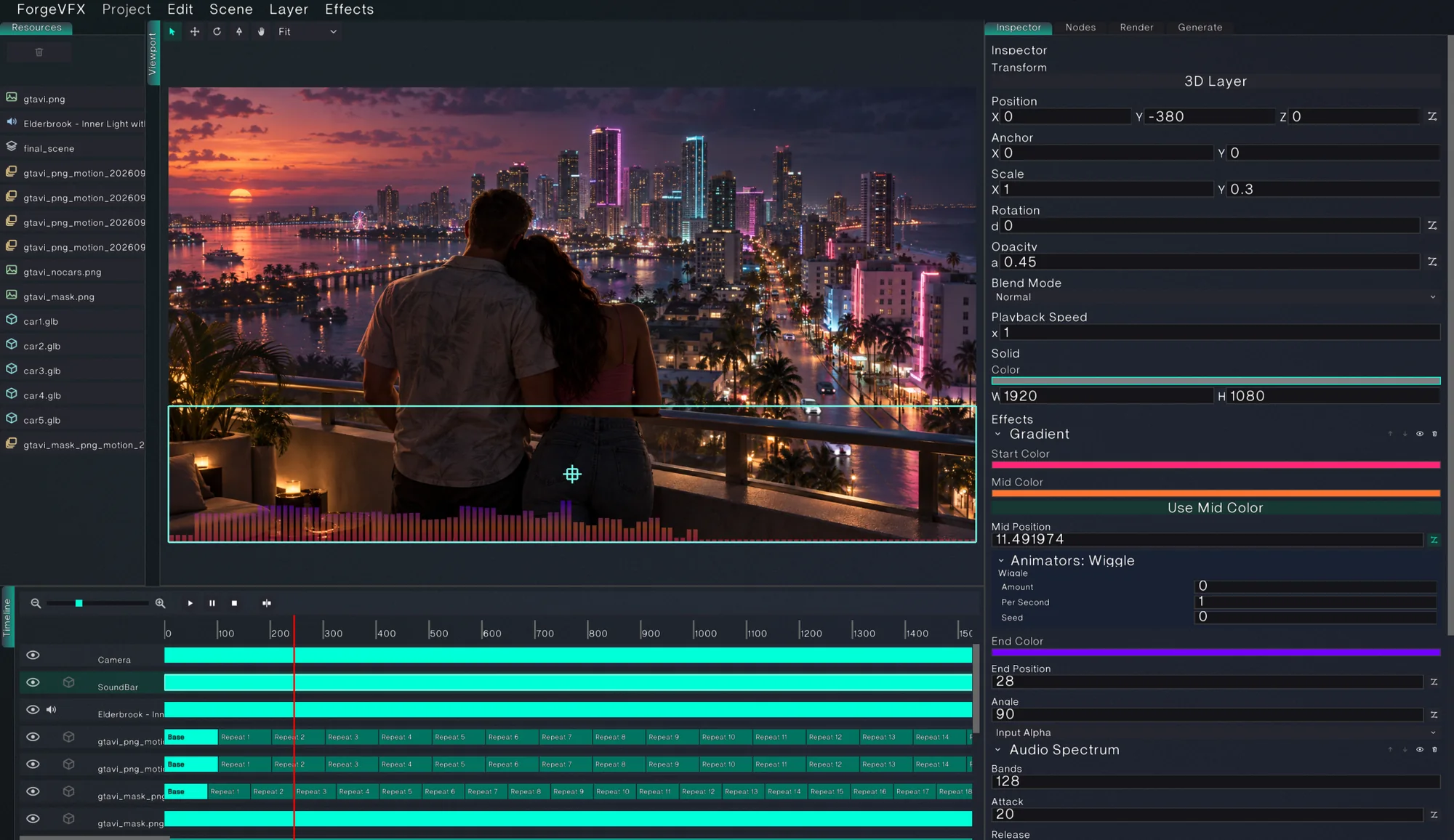
Every layer, every parameter, on one timeline.
Video, image sequences, SVG, text, shapes, solids, audio, nested scenes and glTF models all live on the same frame-accurate timeline.
- Keyframes on any parameter, with fades and a seeded wiggle layered on top
- Any layer can go 3D and be seen through a scene camera
- Normal, Add, Multiply and Screen blending on premultiplied alpha
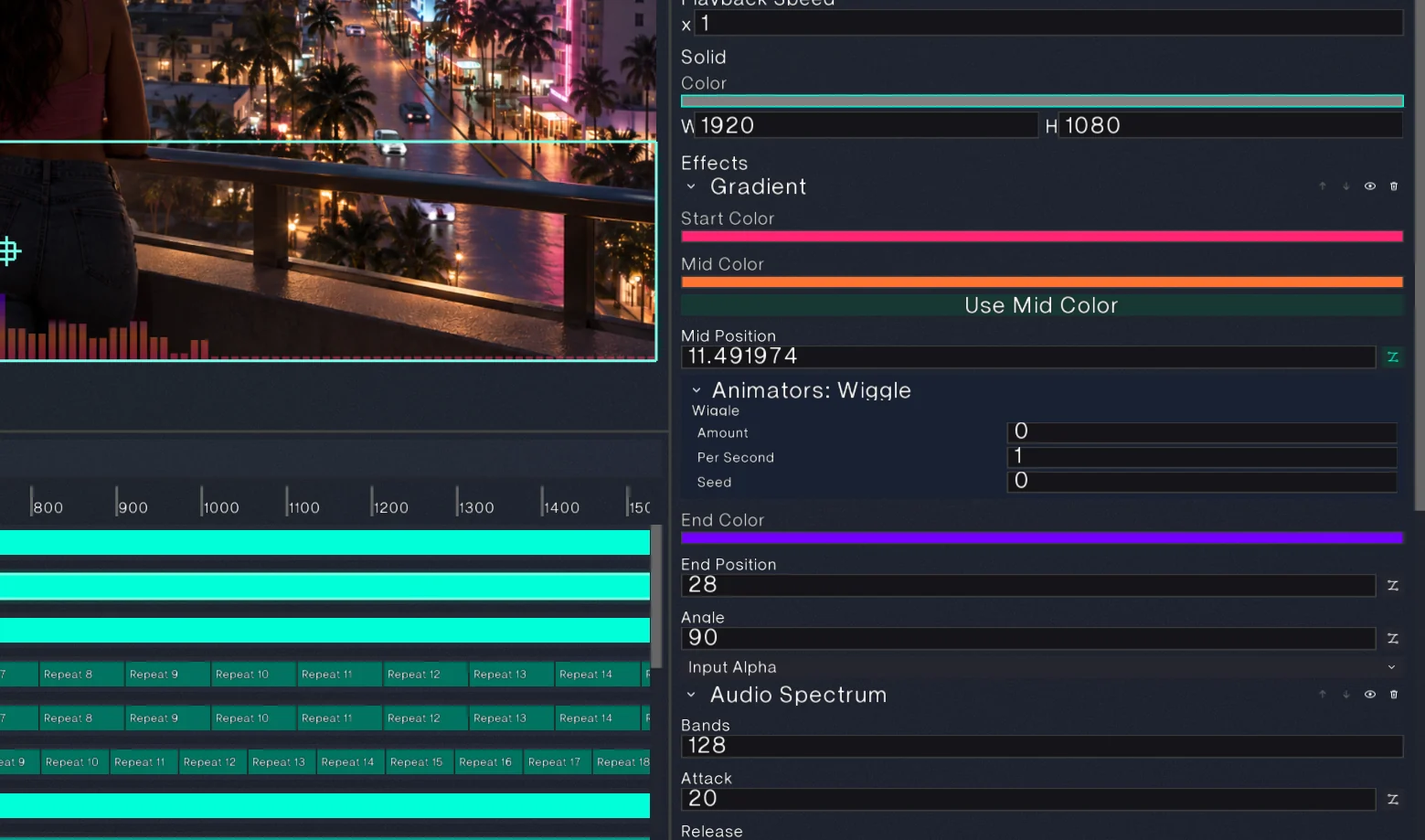
- An Audio Spectrum effect that draws from a layer’s sound
03 · Effects
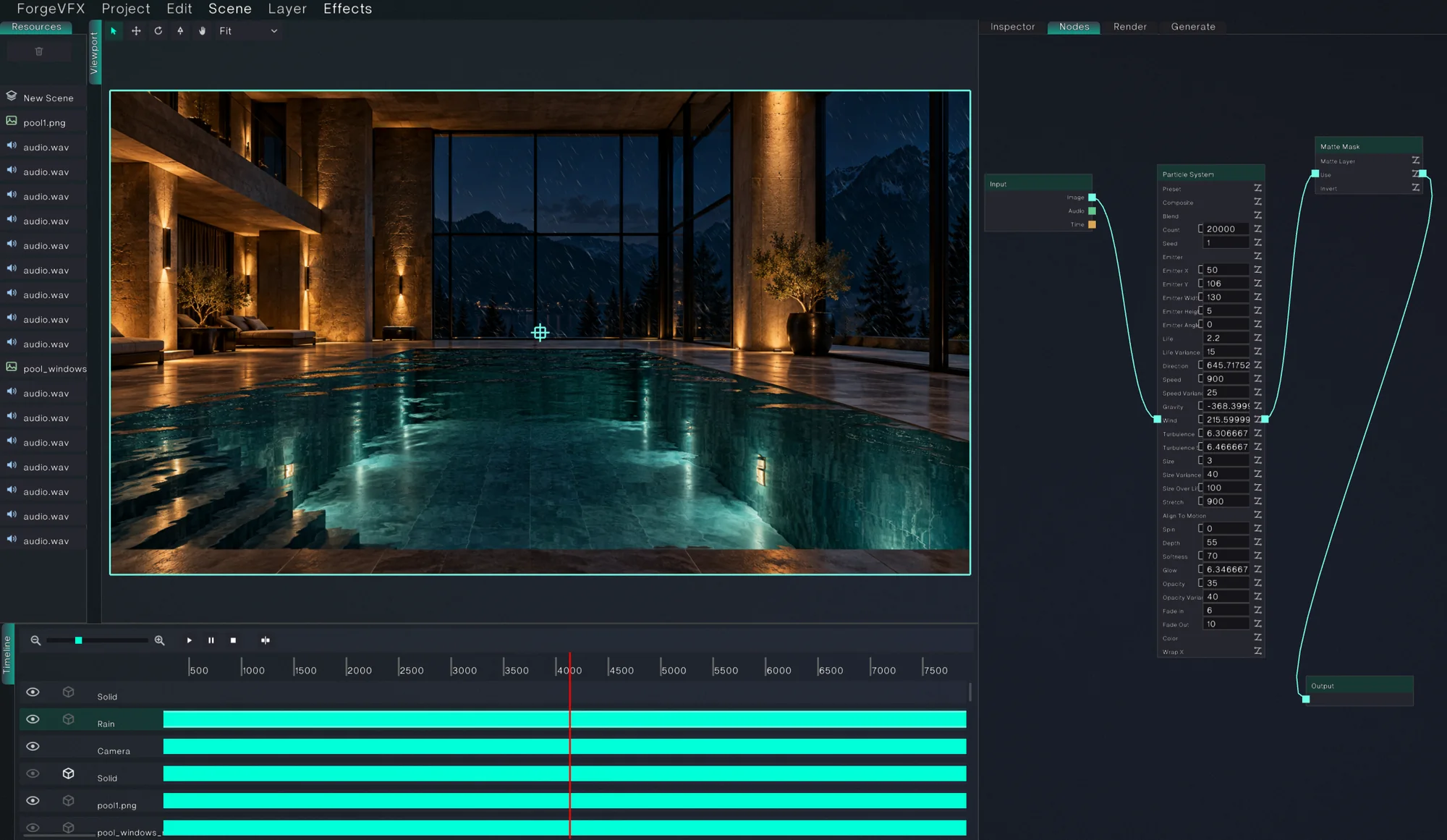
A stack when you want it. A graph when you need it.
Every layer owns a node graph. A simple effect stack is just a straight chain through it, so you can start in the inspector and open the graph the moment a shot gets complicated.
04 · Deliver
Straight to production formats.
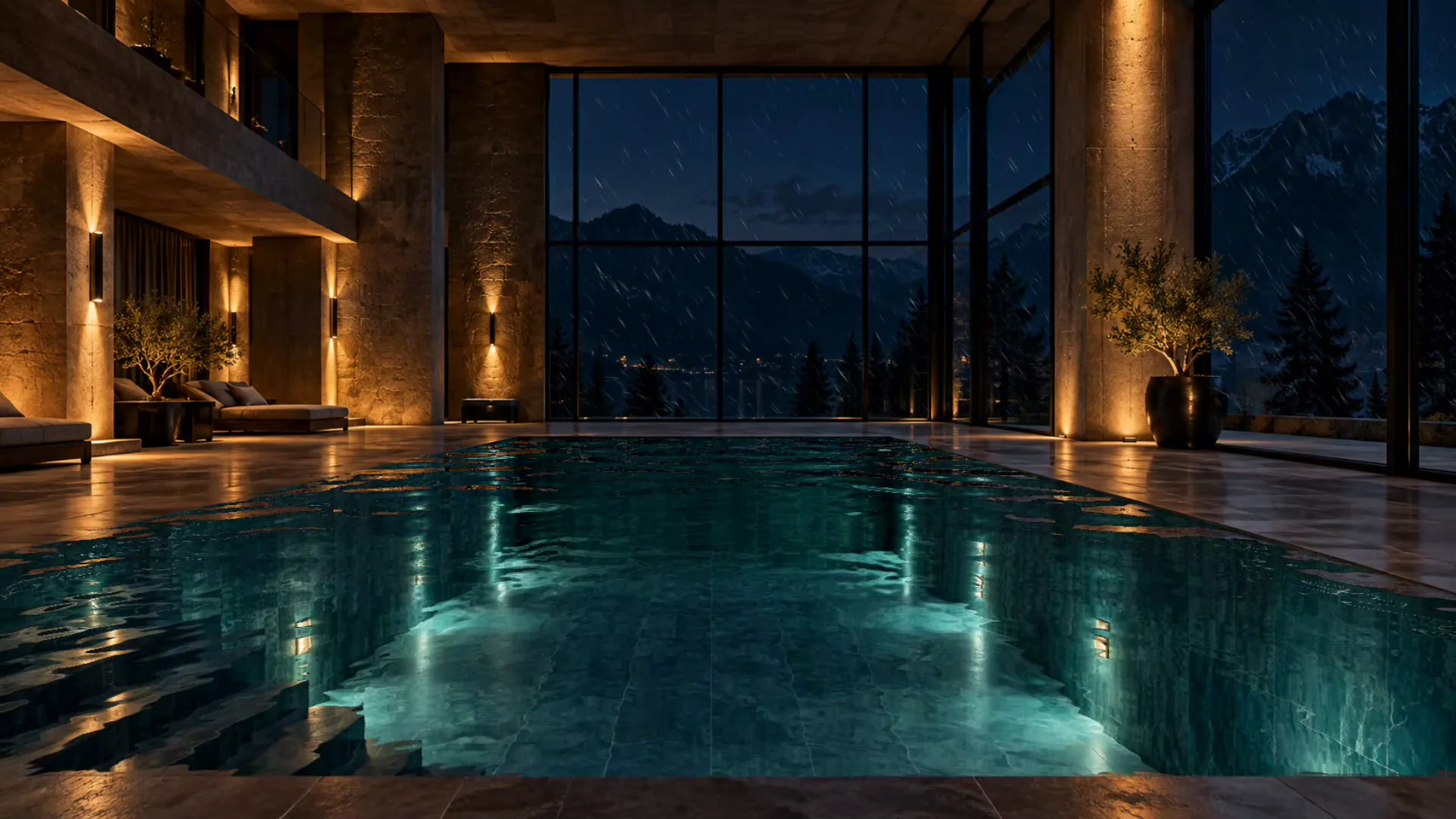
The graph above, rendered: twenty thousand rain particles, held behind the glass by a matte.
Hardware encoders are probed per codec through VideoToolbox on macOS and Media Foundation on Windows.
05 · Engine
Built on its own renderer.
No game engine, no UI toolkit. Forge draws its entire interface and every composite through a small render hardware interface with two interchangeable backends.
- Language
- C++17, Objective-C++ for macOS platform code
- Rendering
- Handle-based RHI. Vulkan by default (dynamic rendering, synchronization2, VMA), OpenGL as the reference backend
- Shaders
- 59, as GLSL 450 compiled to SPIR-V and GLSL 330, addressed by logical name
- Compositing
- Offscreen targets per scene, nested compositions, dirty-flag caching, 4× MSAA
- Compute
- Compute-shader effect path on Vulkan, fragment fallback on OpenGL
- Decoding
- Multi-cursor video readers that walk forward instead of seeking
- Generation
- Python sidecar over a line protocol, Hugging Face diffusers, ONNX Runtime depth
- Platforms
- macOS, Windows, Linux
4K export, Apple M2, sustained
A profiling pass fixed an unoptimized build, stray validation layers, per-frame buffer reallocation, a presentation path that tied export to the display's refresh rate, and a scalar copy into the encoder that became 3.8× faster with NEON. Output stayed bit-identical throughout.
Free. Open source next.
Made to be shared.
Forge VFX will be free to use, and the source is being prepared for release under the GNU GPL v3, the license behind Blender, Krita and Kdenlive. Every fork stays open.
Questions
Is Forge VFX free?
Yes. It will be free to use, and the source code is planned for release under the GPL v3.
Does anything leave my machine?
No. Generation runs on local models. Nothing is uploaded, and there are no accounts or usage credits. A free Hugging Face sign-in is only needed to download models whose publishers gate them.
What hardware do I need?
The editor runs on any GPU with Vulkan or OpenGL support. AI video generation is the demanding part: Wan 2.2 5B is comfortable with 12 GB of VRAM and 16 GB of system memory, and runs from 6 GB of VRAM.
When can I download it?
There is no public build yet. Join the Discord to follow development and hear first when builds are available.